
Rosaria Chifari | Fundació ENT
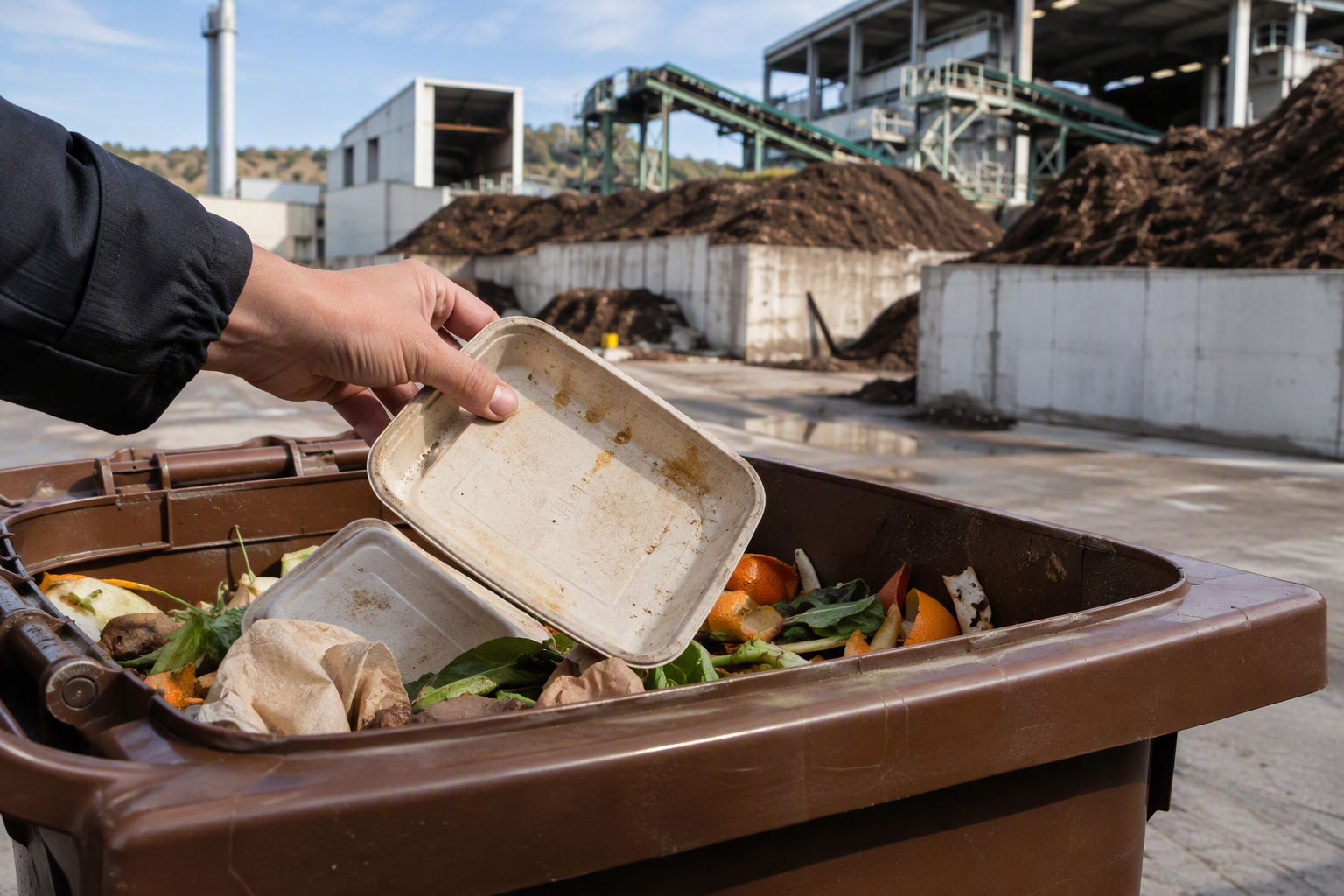
Packaging is essential to modern production and consumption systems, protecting products and facilitating their distribution. Prevention, reuse and high-quality recycling remain central priorities, but some packaging applications may require alternative end-of-life routes, particularly when packaging is difficult to separate from food or other organic residues after use.
In this context, biodegradable and compostable packaging (BCP) is increasingly considered for specific applications where compostability can provide environmental or operational benefits (1). BCP can include different materials and should not be confused with bio-based packaging. A material can be bio-based without being biodegradable or compostable, while compostable materials must biodegrade and disintegrate under defined composting conditions and within a specified timeframe (1, 2).
The sustainability of these materials cannot therefore be assumed from their origin or biodegradability alone. Their performance depends on factors such as feedstock sourcing, production processes, resource use and, importantly, whether they are collected and treated at end of life (3).
The Packaging and Packaging Waste Regulation (PPWR), Regulation (EU) 2025/40, adopts a material-neutral approach for certain packaging formats, including specific tea, coffee and beverage units, and establishes compostability requirements for selected applications where this end-of-life route can provide environmental or waste-management benefits (4,5). This can be particularly relevant where separating packaging from organic contents is difficult and compostability can facilitate biowaste collection and treatment.
Packaging designed for industrial composting can fulfil its intended function only if it is correctly identified, collected and treated under suitable conditions. Industrial compostability should not be confused with home compostability: industrial facilities generally operate under more controlled temperatures, moisture and process conditions (5).
Since the end of 2023, EU Member States have been required to separately collect biowaste under the Waste Framework Directive (6). This raises an important question: under which conditions can BCP be effectively co-composted with biowaste?
Industrial composting plants were primarily designed to process biodegradable organic materials, and the behaviour of BCP may vary according to treatment conditions.
Compliance with an industrial compostability standard does not guarantee identical behaviour in every facility as performance depends on factors such as temperature, moisture, aeration, particle size and residence time (7,8).
The PPWR refers to EN 13432:2000, Packaging – Requirements for packaging recoverable through composting and biodegradation. It establishes requirements concerning biodegradation, disintegration, effects on the composting process and compost quality, and
can continue to be used as guidance until new harmonised standards are adopted (5). The PPWR also points towards future standards that better reflect actual treatment conditions, taking into account parameters such as retention time, temperature and mixing.
In practice, compostable packaging that has not sufficiently disintegrated before screening may end up in the reject fraction. BCP may also be removed during pre-treatment because compostable and conventional packaging can be difficult to distinguish (9).
Labelling, consumer behaviour, separate collection systems and treatment infrastructure therefore all influence whether BCP reaches and completes the intended biological treatment route.
The PPWR makes this system dimension explicit: Member States may require additional packaging formats to be compostable where suitable collection systems and adequate treatment infrastructure ensure that they actually enter the biowaste-management stream (5).
However, approaches still differ across Europe, including rules on biowaste collection, acceptance of compostable packaging and compost quality.
The key issue is therefore not only whether packaging is certified as compostable, but whether the entire biowaste management system can handle it effectively. This must be achieved while maintaining efficient plant operation and producing stable, safe and high-quality compost.
These are the challenges that COMPERF4EU – Optimising Biowaste Composting Plant Performance for a Circular and Safe Bioeconomy Across Europe (10) seeks to address. Coordinated by Fundació ENT, the project will investigate how national policies, acceptance criteria, treatment systems and compost quality requirements influence the integration of BCP into existing composting systems.
COMPERF4EU will benchmark composting plant performance across ten selected EU and non-EU countries using Key Performance Indicators to identify best-performing practices and understand how technological, operational and regulatory conditions affect performance.
A specific assessment will focus on EN 13432-compliant BCP, using plant-level data from facilities accepting these materials to examine their behaviour across the different process stages: pre-treatment, active composting, maturation and final screening. It will assess whether they biodegrade and disintegrate effectively or are removed as rejects, and how their presence affects process performance and compost quality.
By combining plant-level evidence, literature reviews and stakeholder engagement involving composting operators, public authorities, composting associations and BCP designers and producers, COMPERF4EU will help clarify what “adequate treatment infrastructure” means in practice and identify the conditions under which compostable packaging can be successfully integrated into biowaste treatment.
For selected applications, BCP may become a valuable part of the biological cycle of materials when packaging characteristics and design, collection systems and treatment infrastructure are properly aligned. The key question is therefore not only “Is this packaging compostable?” but also “Under which real conditions can it be effectively co-composted with biowaste?”
References
(1) European Commission, 2022. EU policy framework on biobased, biodegradable and compostable plastics. COM(2022) 682 final.
(2) Eunomia Research & Consulting, 2026. Market-Pull Measures for Bio-based Plastics in EU Product Legislation: The Problem Definition, Baseline and Policy Option Overview. Version 4.0, August 2026.
(3) Feijoo Costa, G., 2026. ¿Cómo de sostenibles son los bioplásticos? Residuos Profesional, 21 September 2026.
(4) European Parliament and Council of the European Union, 2025. Regulation (EU) 2025/40 of 19 December 2024 on packaging and packaging waste, amending Regulation (EU) 2019/1020 and Directive (EU) 2019/904, and repealing Directive 94/62/EC.
(5) European Commission, 2026. Guidance document for Regulation (EU) 2025/40 on packaging and packaging waste. C(2026) 3702 final.
(6) European Parliament and Council of the European Union, 2008. Directive 2008/98/EC on waste and repealing certain Directives (Consolidated version).
(7) Gastaldi, E., Buendia, F., Greuet, P., Benbrahim Bouchou, Z., Benihya, A., Cesar, G. & Domenek, S., 2024. Degradation and environmental assessment of compostable packaging mixed with biowaste in full-scale industrial composting conditions. Bioresource Technology, 400, 130670. https://doi.org/10.1016/j.biortech.2024.130670
(8) Suarez Murcia, J.C., Huet, G., Lamarque, J., Gastaldi, E., Sambusiti, C., Puchelle, V., Grassl, B., Domenek, S. & Monlau, F., 2025. Chemical composition and mesophilic anaerobic digestion of commercial compostable food packaging: Implications for bio-waste management. Bioresource Technology, 424, 132273. https://doi.org/10.1016/j.biortech.2025.132273
(9) Körner, I., Redemann, K. & Stegmann, R., 2005. Behaviour of biodegradable plastics in composting facilities. Waste Management, 25(4), 409–415. https://doi.org/10.1016/j.wasman.2005.02.017