
Circular economy indicators at the regional level: progress and implementation of regional material flow accounting.
Sergio Sastre Sanz | ENT Environment & Management
The circular economy has rapidly matured as a public policy framework. In just a few years, it has become a pillar of environmental and industrial policy that requires more precise tools for diagnosis, prioritisation and monitoring. In this process, material flow accounting (MFA) has gained a central place. It is not merely a technical tool, but a framework that makes it possible to describe the economy of a territory in physical terms and, on that basis, to build indicators such as domestic material consumption (DMC), material productivity and the circular material use rate.
Its relevance is clear. A significant part of the debate on the circular economy still relies on partial indicators, often focused on waste, recycling or specific sectoral actions. These indicators are useful, but insufficient to understand the material structure of an economy. MFA broadens the perspective: it quantifies the physical inflows and outflows of materials, makes external dependencies visible, identifies dominant material profiles and helps interpret the relationship between economic activity and resource use. In short, it provides a structural reading of the physical economy of territories.
This issue is especially important at the regional level in those countries where a significant share of decision making relies on the subnational level. For example, in Spain, many of the competences with a direct bearing on the circular economy lie with the autonomous communities: waste management, industrial policy, etc. However, strategic ambition has often progressed faster than information systems. This gap between planning and evidence limits the ability to formulate accurate diagnoses, rank priorities and evaluate results with sufficient traceability.
In the Spanish case, although implementation remains uneven, six autonomous communities already have updated MFA results and derived indicators sufficiently developed to allow a first comparison: Navarre, the Basque Country, Catalonia, the Balearic Islands, the Canary Islands and the Community of Madrid. It shows that the regional application of MFA has moved beyond being a methodological possibility and is becoming established as a useful statistical basis for the design and monitoring of public policies.
These experiences do not follow a single trajectory. Catalonia and the Basque Country are the most consolidated cases, both in terms of continuity of time series and the integration of material indicators into public monitoring frameworks. The Balearic Islands and the Canary Islands extend the analysis to island economies, where MFA makes it possible to capture external dependence, logistical vulnerability and exposure to external factors with clarity. Navarre shows how these indicators can be developed in response to the need to inform regional policy, structure priorities and identify opportunities and bottlenecks. Madrid, for its part, helps deepen the interpretation of a highly service-based economy, where lower material consumption is still closely linked to material dependence and to specific analytical needs.
In a broader European context, Spanish regions can be regarded as pioneers in the development of regional MFA. Earlier research demonstrated that harmonised material flow accounts could be produced for all 17 Spanish autonomous communities for the 1996–2010 period. Several regions later translated that analytical groundwork into updated official or policy-oriented regional systems. This places Spain alongside a still limited group of European regional experiences, such as Flanders, and Italy, where Istat approached regional MFA indicators.
The comparison across these communities highlights two main points. First, there are very different material profiles, linked to distinct territorial and productive structures. Second, there are also differences in the institutional capacity to measure these processes. Where MFA exists, the discussion on the circular economy can rely on a stronger empirical basis and move from general formulations towards more specific questions.
Moreover, the potential of MFA is not exhausted by the most common indicators. Combined with other analytical tools, such as input-output frameworks, it can support the calculation of material footprints and more precise sectoral analyses of supply chains, productive specialisation, external dependencies or final demand. This capacity for articulation broadens its usefulness for public planning by connecting the aggregate reading of socioeconomic metabolism with more detailed diagnoses of sectors, activities and demand patterns.
In this sense, the main contribution of the Spanish experience is not only that it has shown that regional accounts are possible. It has also shown that they are useful. The existence of a critical mass of regions with comparable results opens up a valuable field of learning for the rest of the regions and makes it possible to move towards more robust monitoring frameworks, better connected to the national and European scales.
The conclusion is clear. The circular economy needs a statistical infrastructure commensurate with its political ambition. At the regional level, MFA is beginning to consolidate as one of its central building blocks and helps the circular economy move from the realm of intuition to that of evidence-based planning.
References and links:
Eurostat. 2018. Economy-wide material flow accounts. Handbook. Publications Office of the European Union, Luxembourg.
Sastre, S. 2021. Resources extraction, trade and waste management: a regional approach to the Spanish socioeconomic metabolism. Phd Thesis. Institut de Ciència i Tecnologia Ambeintals. Universitat Autònoma de Barcelona.
Sastre, S., Carpintero, Ó., Lomas, P.L. 2015. Regional material flow accounting and environmental pressures: The Spanish case. Environmental science & technology 49: 2262-2269.
Carpintero, Ó., Sastre, S., Lomas, P.L., Arto, I., Bellver, J., Delgado, M., Doldán, X. et al. 2015. El Metabolismo Económico Regional Español. Carpintero, O. (ed.),. FUHEM, Madrid.
Statistics on material flows at EU level: https://ec.europa.eu/eurostat/databrowser/view/env_ac_mfa/default/table?lang=en
Statistics on material flows at national level for Spain: https://www.ine.es/dyngs/Prensa/CFM2023.htm
Statistics on material flows at regional level, Catalonia: https://www.idescat.cat/pub/?id=cfm&lang=es
Statistics on material flows at regional level, the Basque Country: https://www.euskadi.eus/web01-s2ekono/es/contenidos/informacion/estatistika_ing_090217/es_def/index.shtml
Statistics on material flows at regional level, Balearic Islands: https://ibestat.es/estadistica/economia/cuentas-economicas/cuenta-de-flujos-de-materiales/
Data on material flows of Italy at regional level:
https://www.istat.it/it/files/2021/06/Economia-Ambiente.pdf
Figura 1. Consumo doméstico de materiales de una selección de regiones españolas, 2014-2022.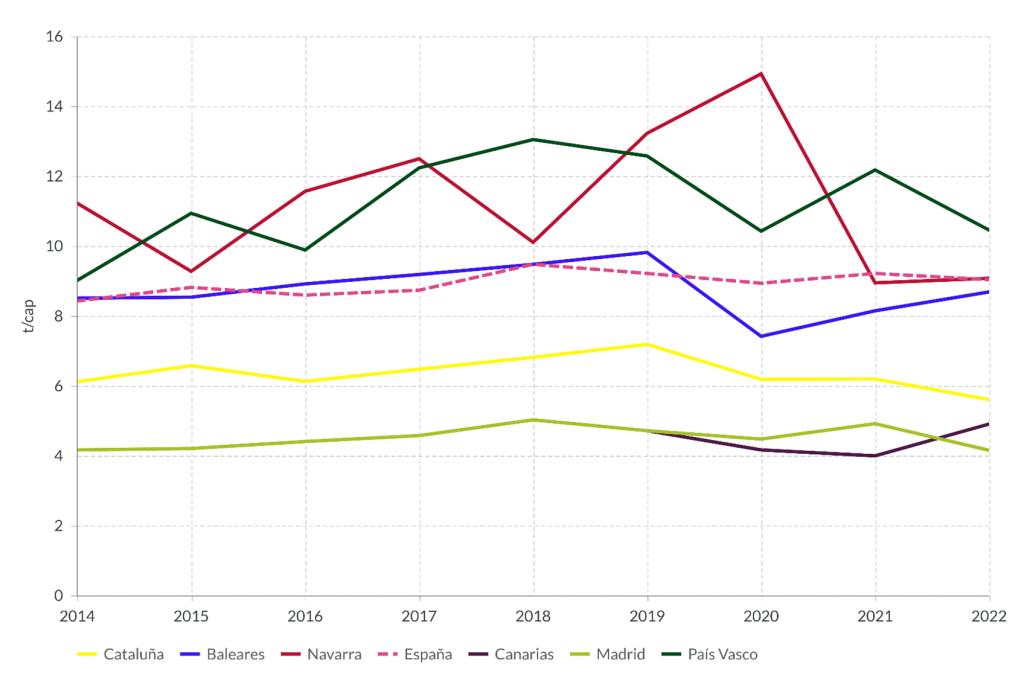 Fuente: Elaboración propia a partir de Idescat (Cataluña), Ibestat (Baleares), Eustat (País Vasco), INE (España) y comunicación personal en el caso de la Comunidad de Madrid , Navarra y Canarias.
Figura 2. Productividad material (a precios corrientes) de una selección de regiones españolas, 2014-2022.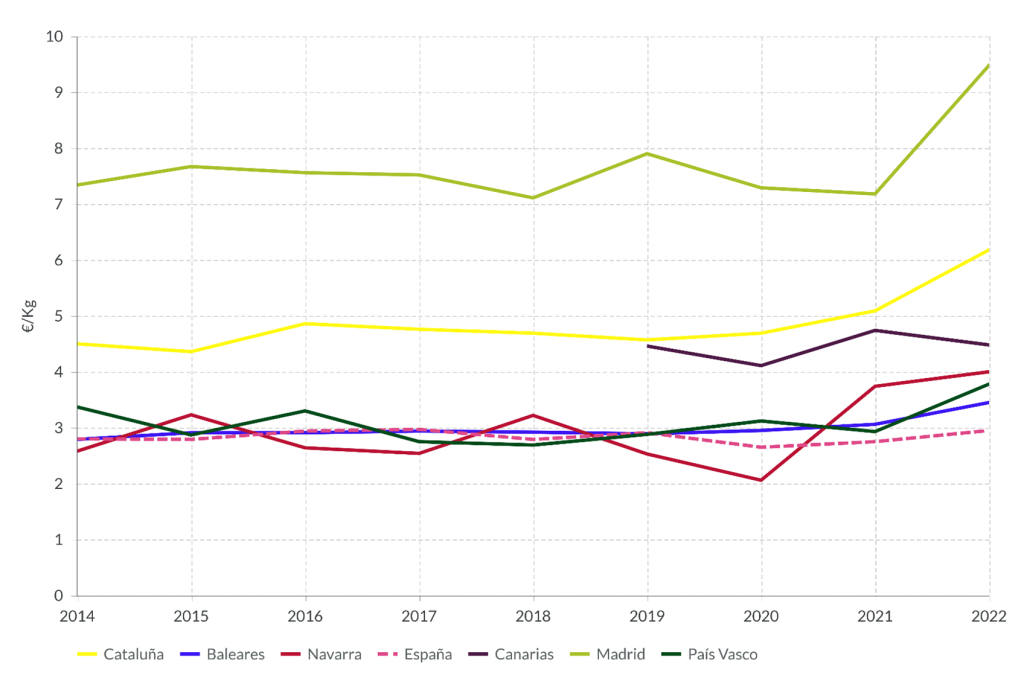 Fuente: Elaboración propia a partir de Idescat (Cataluña), Ibestat (Baleares), Eustat (País Vasco), INE (España) y comunicación personal en el caso de la Comunidad de Madrid , Navarra y Canarias.