
LIFE BIOBEST contributed to the sustainable and efficient management of the whole bio-waste value chain with an unequivocable approach for sharing and transferring knowledge and providing recommendations to collectively evolve in the green transition.
LIFE BIOBEST project outcomes identify and validate the current Best Practices and management instruments along the bio-waste management chain (from generation to treatment) that allow the production of high-quality compost and digestate. The project focuses on supporting both upper and lower levels of governance, including policymakers, waste management organisations, and technical practitioners, to facilitate the widespread adoption of recognised Best Practices and instruments.
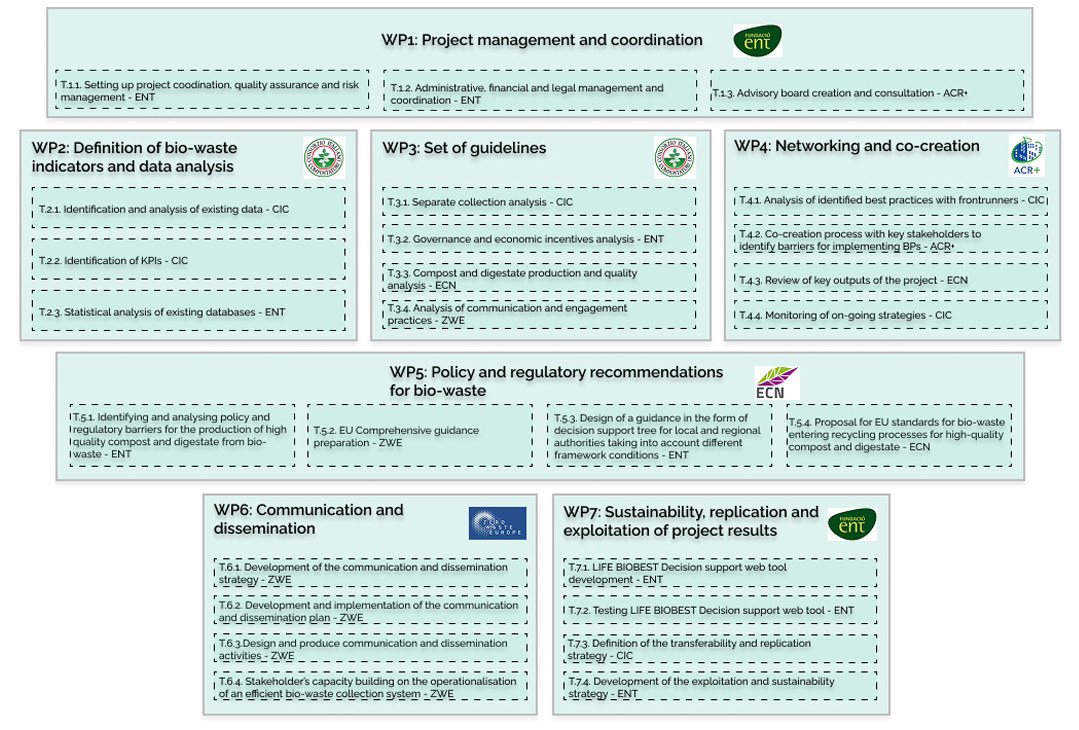
Workplan
Main LIFE BIOBEST outputs
- D2.1 Improved and homogenised datasets on municipal bio-waste management supports the establishment of a series of reference Key Performance Indicators (KPIs). The dataset contains fundamental information on bio-waste collection and treatment in nearly all 27 MS, along with detailed data on kitchen and garden waste collection per capita at the municipal level for Italy, Denmark, and Catalonia.
- D5.2 Policy brief identifies the gaps in the regulatory framework and systemic barriers obstructing efficient bio-waste management with high capture rates of high-quality material.
- D3.1 Guideline on separate collection provides an overview of the different bio-waste separate collection schemes and assesses the pros/cons. This guideline includes in an annex, “Best practice cases on bio-waste collection” that focus on collection from households and other producers in various contexts. Best practice cases on bio-waste collection” that focus on collection from households and other producers in various contexts.
- D3.2 Guideline on governance and economic incentives discusses the governance tools and economic instruments needed to improve management schemes. The guideline presents these instruments alongside examples of their application and includes an analysis of the economic viability of best practices in bio-waste management from separate collection to treatment.
- D3.3 Guideline on quality compost and digestate breaks down the treatment technologies and resources that support the production of compost and digestate. The guideline provides insights about the processing options, analysis of product characteristics, quality assurance systems as well as related EU legislation and the ECN’s Quality Assurance Scheme.
- D3.4 Factsheets on the analysis of best practices in communication and engagement from various countries delves into the topic of public communication and education. It includes an analysis of experiences from frontrunners and provides insights into the impact of communication activities, highlighting the need for well-coordinated outreach efforts combined with convenient collection systems to encourage citizen participation.
- D5.3 Proposition of quality standards aims to establish harmonised quality standards for bio-waste entering recycling processes across EU MS. It includes recommendations for a standardised methodology for quality assessment via waste compositional analysis and/or visual inspection, as well as a control value for impurities in bio-waste. This report was drafted with regards to §22, point 3 of the Waste Framework Directive (WFD).
- D5.4 Comprehensive guidance for the EU presents key policy recommendations to strengthen the EU legal framework for bio-waste management. Drawing from extensive research and stakeholder consultation, this document outlines three interconnected areas for improvement: boosting effective models for separate collection and recycling, promoting reliable markets for compost and digestate, and enhancing monitoring and enforcement of bio-waste regulations.
- D2.3 Assessment matrix evaluates and consolidates contextual factors that affect bio-waste management, providing in-depth descriptions of each. Factors are placed beside recommendations and theoretical scenarios, which stakeholders can use to compare to their own context.
- D5.1 Decision support trees function as a tool for municipalities and regional authorities to evaluate their specific difficulties and context. Following a preliminary self-assessment, the decision support trees disaggregate barriers that inhibit bio-waste implementation, pairing them with resources and recommendations from LIFE BIOBEST outputs.
Layman Report
#LIFEBIOBEST | From waste to resource